
My, my, my. Not only is it suddenly 2018 but it’s suddenly February 2018 and, pardon me, where has the time gone?! I don’t know about you guys, but last year sure got away from me and to think we’re already well into the second month of a brand new year and Christmas was an age ago and summer is nearly over and there are Cadbury creme eggs in the shops and, oh ALL THE THINGS!
Hello. How are you? Nice to see you. Your hair looks bloody great.
I’d sure like to get back into the habit of regular blogging and recapping my January reading seems a good place to start. So, without further ado and in no particular order…
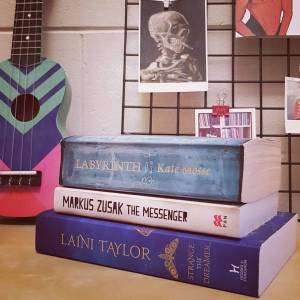
The Messenger – Marcus Zusak (2002)
After becoming something of a local celebrity for foiling a bank robbery, nineteen-year-old Ed Kennedy starts receiving mysterious playing cards in the mail, setting his uninteresting life into a cryptic and tumultuous spin. A mixed bag of self discovery, small town desperation and human connection, The Messenger could have felt cliche or contrived, but Zusak presents a story that is unpretentious and characters that are believable and raw.
Where Zusak particularly succeeds is in capturing the necessary ordinariness of his setting, tinging small town Australia with a kind of humble sadness that makes Ed’s journey as a disaffected almost-adult all the more poignant. Though certainly problematic in places, The Messenger made for pretty compulsive reading and was tricky to put down.
3.5/5 stars.
Strange the Dreamer – Laini Taylor (2017)
The big strength of Laini Taylor’s writing is how effortlessly she seems to blend vivid imagination, original storytelling and lyrical prose. It was what made the Daughter of Smoke and Bone series so enjoyable and what here sweeps the reader so fully into the fictional world of Lazlo Strange – daydreamer, orphan and librarian – to solve the mystery of the lost city of Weep.
The first in a planned duo of books, Strange the Dreamer feels part fairy-tale and part classical epic. Cleverly conceived and beautifully written, with good doses of adventure, conflict, gods and monsters, softness and light, it gets a whole-hearted two thumbs up from me.
4/5 stars.
Labyrinth – Kate Mosse (2005)
A $4 op shop bargain and veritable doorstop of a book, Labyrinth promised secrets, adventure and conspiracy all wrapped up around that old chestnut, the true Grail. With parallel storylines of medieval and modern day France, and two characters with a mysterious connection, Labyrinth, for the most-part, delivers.
On discovering two skeletons in a cave in the French Pyrenees, the crux of mystery resides with Alice in 2005 but following Alaïs circa 1209 is clearly where Mosse is most at home. Though highly effective as a sweeping historical narrative which paints medieval France with a deft hand, the story could have been 100 pages shorter and been no worse off. The main characters are well-realised and compelling, though some of the supporting characters felt under-done and largely expositional despite hints of potential for being interesting in their own right (Shelagh, for example). These quibbles aside, there is more than enough suspense and intrigue to keep the pages turning (all 700 of them).
3/5 stars.
‘Til next time,
 April All Year