Reference Checking: pet hates and phone tag

I work in HR and I think reference checks are balls. There, I said it. I’m sorry. I know it’s an unpopular opinion. Send the HR police. I will surrender my badge.

In places I’ve worked before, ref checking has been treated in turns as anything from a box-ticking exercise to the ultimate be all and end all. The intent is of course to verify the truthiness of the candidates skills and experience. But here’s the thing: no one with half a brain is going to list a referee who is going to give them a bad wrap. And if they don’t have half a brain, how the heck did you miss that in the early stages of the recruitment process? That’s on you, kids.

The best referee, in a lot of cases, will be a candidates current manager – especially if they have been in that role for a long time. That might obviously be awkward: not many people want their boss to know they are looking to throw in the towel asap. So right off the bat, I’m speaking to someone whose knowledge of my preferred candidate’s work performance could be 4 or 5 years out of date.

So maybe my candidate lists someone else. The number of times I have played phone tag for two days with Dave, only to find out that Dave wasn’t Melanie’s manager at all – he was just a colleague. Nice chatting, Dave, but you’ve been no actual help.

And obviously there was that whole thing from last year when Hamish and Andy asked a random guy to act as a referee and he actually did a pretty good job of faking it. They called him ‘the best bloke in Australia’ while HR peeps and recruiters cried quietly into their coffees.
job-hunt

So if everyone is only listing good referees, or non-manager referees, or even fake referees, is there really value in the reference checking process? Are they a waste of time? Maybe. Are they going away? Probably not.

And that’s kind of sad, because it can be a very time consuming process that, if your questions aren’t effective, may yield very little reward. I know plenty of candidates who received glowing references and then turned out to be problematic or unproductive employees. I think value would be better added through more stringent screening processes and better interview questions which really probe for detail. But ref checking doesn’t seem to be going anywhere.

With that in mind, if you are an applicant, there are a few things you can do to make this step in the process a smooth one. Help me out, you guys.

  • List relevant, work-related referees.
  • Ask before you list. Give your referees a heads up that you would like them to act as a referee, checking they will be ok with that.
  • Don’t list personal referees (unless you are a school leaver with no work experience) – honestly, no one cares.
  • Do indicate where you worked with the referee. Don’t just say “Mike Smith on x number”. Context is key. Say “Mike Smith, former manager at Woolworths, x number”.
  • If you interview, give your referees a heads up that they may get a call. It helps them prepare, it helps HR people get phones answered, and even if we don’t like ref checks, we like that.

phone

‘Til next time,

Sig


Adulting 101: How to write a resume

Listen up: it’s time to get real. It’s an unfortunate truth that one of the perils of being an adult is, occasionally, having to actually be an adult. So. Let’s talk jobs. In my real life, as part of my real job, I see a lot of resumes.

A lot.

And I’ll let you in on a trade secret: heaps of them genuinely SUCK. You guys. Your resume is one of the most vital documents in your working life. Why aren’t you giving it some love? For a lot of jobs it’s the only introduction you will get and bad impressions (or worse: wrong impressions) matter.

job-hunt

On average, for each job I recruit for, I see a minimum of a hundred applications and I have to get through them quickly. Sometimes you hear that recruiters spend less than a minute on your resume (it’s true, for an initial scan at least) and I know that makes you question why you would spend time on it at all if that is the case. Here’s why: if you are looking for a job, you don’t want to piss off the gatekeeper of the jobs.

Don’t make me join the dots myself. Show me what I want to hear. Make it easy for me to see how you are a good fit for my job. Pro tip: the easier you make a recruiter’s life, the more they will like you.

Some things you may want to consider:

Ditch the cover page and the photo. Save the planet and get down to business. And if you really insist on a photo, choose one that is semi professional and not a selfie where you’ve obviously cropped out your bestie but your makeup is on point.

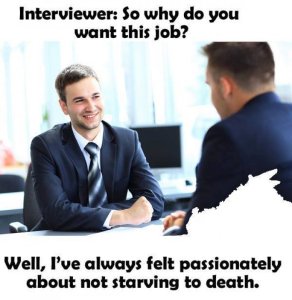
Bin the objective, unless you really, really have one. You’re applying for this job because you want this job, presumably.

so-why-do-you-want-this-job-meme

I don’t care what subjects you studied in school. At most, list where you went and what year you finished. If it was more than say five years ago, you could easily leave it off. By that stage, your experience should speak for itself.

List dates of employment not length of service. I want to know if the eight months you worked at Kmart was the last eight months or eight months ten years ago. I can do basic maths (mostly), just give me a point of reference for how recent your experience is. If you’ve got glaring gaps that you can explain (travelling, raising babies), tell me so.

Give me context. Don’t just list job titles, tell me about what you did in the role. An Admin Assistant in one company might be purely responsible for filing and copying. In another they might also do reception, data entry, minutes and diary management, banking and bookkeeping. If you just put “Admin Assistant”, it keeps me guessing and I hate guessing. Admin Assistant =/= Admin Assistant.

Format neatly. Anything that makes your resume easy on the eye so I can get a picture of who you are quickly, is going to help me. It doesn’t have to be a work of art, but things like consistent headings and dot points are helpful. I don’t want to see big chunks of text, weird fonts (I’m looking at you, Papyrus), jobs listed out of order, and so on.

Don’t waste your space. Ideally, you want your resume to be two to three pages. Don’t fill it with inspirational quotes to show how deep and motivated you are (“You miss 100% of the shots you never take” – Wayne Gretzky). Ain’t nobody got time for that. Focus on what is relevant and recent because that has the most bearing on where you go next. I’m going to pay most attention to your last couple of roles, give or take, depending on how long you’ve been in them. Remember your resume does not have to be an exhaustive chronicle of your entire life back to your 1998 after school job where you:

  • advised on menu items
  • took customer orders
  • handled cash
  • served food

Ugh, seriously stop. Why are you listing that? It’s 2016 and you’ve been working in IT project management for the last six years.

Customise it. Generally, one size does not fit all. When applying for a job, your resume’s sole purpose is to showcase what skills and experience you have in relation to the role you are applying for. So think about what the ad has asked for and how you can demonstrate right off the bat that you have the goods.

Proof read. Bad grammar and spelling errors bug me. And you know what? I’m heaps lazy, so help me out. If I decide I want to call you, don’t make me flip through three pages to find your phone number – put that shit up the front.

‘Til next time,

Sig